Quarteira is different from everything around it. It is not a resort or a holiday complex — it is a town, with permanent residents, eighties and nineties apartment blocks, high-street shops and people who live here all year round.
From the point of view of our work, that translates into something very concrete: here we find the oldest equipment in the region, and with it the hardest and most rewarding cleans.
Equipment that has never been opened
It is the pattern in this area and worth describing as it is.
A split installed twelve or fifteen years ago, in an apartment where the same family has lived ever since. It has never had servicing because it never broke down. The filters were washed a few times, perhaps, in the first years. The unit still switches on and gives some cooling, so nobody has thought about it.
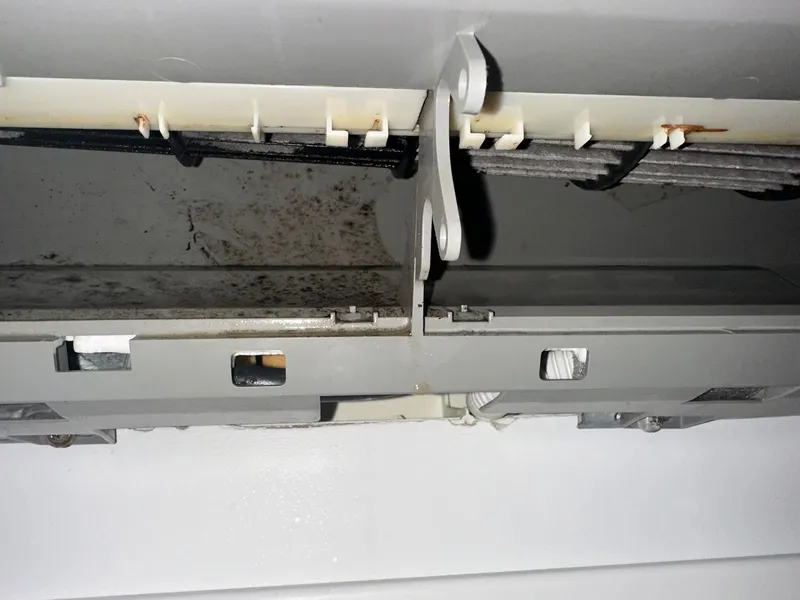
When you open a unit like that, the heat exchanger is not dusty — it is clogged. The fan barrel has a crust on the blades millimetres thick. The drain tray has a dark layer at the bottom and the drainage is partly blocked, which explains the stain that appeared on the wall below a few years ago.
It is a genuine deep clean, time-consuming, and it is where the difference shows most. Research on build-up in residential heat exchangers shows that a typical unit accumulates enough dirt to double the resistance to airflow in about seven and a half years — against a service life of fifteen to thirty. A fifteen-year-old unit with no servicing has spent most of its life working well below what it was sized to deliver.
What we say before starting on an older unit
There is a conversation we always have on units many years old, and we prefer to have it before opening.
On older units, the casing plastics become brittle with time and exposure to heat. Clips and tabs can break during disassembly, however careful you are. It is not common, but it happens.
We say so before starting, assess the condition of the plastics on site, and if there is a real risk we explain and leave the decision to the customer. What we do not do is discover the problem at the end and report it with the part already in our hand.
Is it worth cleaning, or is it better to replace?
It is the most honest question one can ask, and the answer depends on two factors.
If the unit switches on, cools and has no faults, cleaning is almost always the best decision: it costs a fraction of the price of a new unit and recovers a good part of the lost capacity.
If the unit no longer cools even when clean, loses gas often, or makes compressor noises, cleaning will not fix it — and we say so. We do not clean units only for the customer to find out alone that the problem was something else.
High-street shops
Quarteira has traditional shops, cafés and small restaurants with equipment installed many years ago and running daily. Everything above applies, with the added factor of grease in the air in spaces with a kitchen — which clogs the heat exchanger much faster and calls for two visits a year.